Staffing vs. Talent Acquisition vs. Staff Augmentation: What’s the Difference and Which One Does Your Business Need?

What AI Is Actually Doing to the Job Market (It’s Not What You Think)
March 27, 2026
Artificial Intelligence: Hope vs. Hype | Theoris Webinar Recap with Benjamin Hall
May 21, 2026
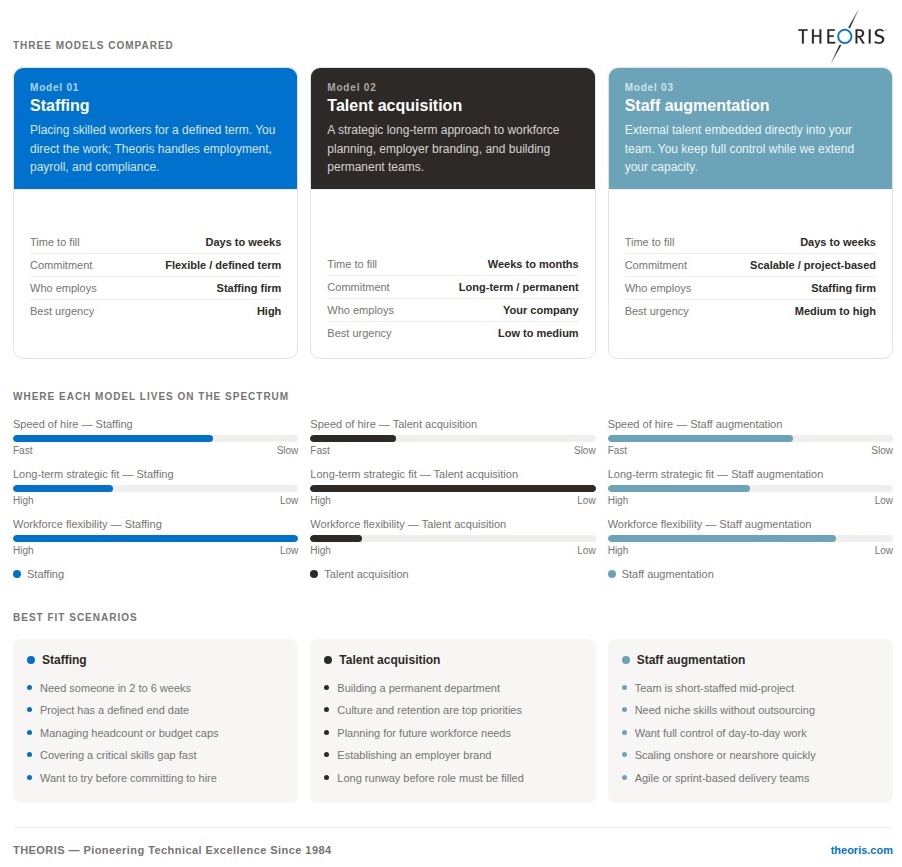
 When most people say “staffing,” they mean contract staffing which is placing skilled workers with a company for a defined period. The worker is typically employed by the staffing firm (like Theoris), which handles payroll, benefits, and employer taxes. The client company directs the day-to-day work.
And staffing is far from a niche solution. According to the American Staffing Association, staffing provided job and career opportunities for about 11 million employees in 2024, with nearly 2.2 million temporary and contract employees working for staffing companies during an average week. This is a massive, mature industry that businesses of every size rely on to stay competitive.
Best for:
- Project-based needs with a clear start and end date
- Filling a role quickly when time-to-fill matters
- Managing workforce headcount without long-term commitments
- Covering leaves of absence, product launches, or compliance deadlines
Within staffing, there are a few different ways to engage.
The right one really comes down to what you need and how committed you’re ready to be:
- Contract: The worker is placed for a fixed term. Great for seasonal demand, sprint-based projects, or short-term expertise needs.
- Contract-to-Hire (C2H): You “try before you buy.” The candidate works as a contractor first, and if it’s a mutual fit, they convert to a full-time employee. This is one of the most popular models in technical hiring because it significantly reduces mis-hire risk.
- Direct Placement (Direct Hire): Theoris sources and vets the candidate, but the worker is hired directly by your company from day one. You get the recruiting expertise without managing the search yourself.
 Most people use ‘talent acquisition’ and ‘recruiting’ like they mean the same thing, and honestly, we get it. They sound interchangeable. But there’s a real difference worth knowing.
Recruiting is reactive. Someone leaves, a role opens up, and you go find a person to fill it. Talent acquisition is the bigger picture. It’s the strategy behind the hiring, focused on where your workforce needs to be six months, a year, or three years from now, not just who you need by Friday.
A true talent acquisition strategy includes:
- Employer branding and candidate experience
- Pipeline development for anticipated future needs
- Workforce planning aligned to business growth
- Long-term relationship building with passive candidates
- DEI hiring initiatives and structured interview processes
Best for:
- Organizations building out a permanent team or department
- Companies with recurring talent needs who want a partner, not just a vendor
- Situations where culture, values alignment, and long-term retention are the priority
 Think of staff augmentation as the best of both worlds. You get external talent embedded directly into your existing team to extend capacity, add specialized skills, or accelerate execution, but without the overhead or loss of control that comes with a full outsourcing engagement.
The key distinction: with staff augmentation, you maintain project control and direction. The augmented staff work as an extension of your team, often indistinguishably from your full-time employees in day-to-day operations.
Best for:
- Teams that are short-staffed but don’t want to outsource the work
- Projects requiring niche technical expertise (e.g., a specific validation methodology, a legacy system, or a specialized engineering discipline)
- Scaling up rapidly without a long-term headcount commitment
- Organizations that want oversight and flexibility simultaneously
Where staff augmentation gets especially interesting is in the onshore vs. nearshore conversation (which we’ll get to in a moment).
Onshore vs. Nearshore: A Factor Worth Considering
One of the most common conversations we have with clients today is around delivery location. For IT and engineering roles especially, geography is no longer as limiting as it once was, but it’s also not irrelevant.
- Onshore staffing and augmentation means your talent is right here in the United States. You get natural cultural alignment, real-time collaboration, and the kind of day-to-day communication that’s hard to replicate across borders. It’s usually the go-to for roles that need someone on-site, in close daily contact, or working in a security-sensitive environment.

- Nearshore is a little different, and honestly, it surprises a lot of clients in the best way. Your talent is based in a nearby country, typically Latin America for U.S. companies, which means time zones are often fully aligned and communication stays unified. You still get strong, highly skilled technical talent, just at a cost point that onshore can’t always match. We’ve seen nearshore grow especially fast in QA, software development, and engineering support roles, and for good reason.
Honestly, there’s no universal right answer here.
It comes down to the nature of the work, how your team operates, how you like to communicate, and yes, budget. Some of our clients use a blended model, onshore leads with nearshore support, to get the best of both. If you want to go deeper on how to choose between the two, we broke it down in detail in this post.
The Theoris Perspective: Why This Distinction Matters in Technical Hiring
For technical professions, the stakes of a bad hire or a talent gap is higher than in most industries. A missed validation milestone can delay a product launch. A gap in your QA team during a critical sprint can compromise release quality. An understaffed engineering team creates technical debt that compounds over time.

This is why we think of ourselves as more than a staffing firm. We’re a workforce partner. When a client calls us, we don’t just ask “what’s the job description?”
We ask:
- What’s the actual problem you’re trying to solve?
- What does success look like 6 months from now?
- How does this role connect to your broader team structure?
The answer might be a contract engineer on-site for three months, or a nearshore QA augmentation team that integrates with a client’s Agile workflow. Other times it’s a direct-hire search for a long-term technical lead.
More often than not, we’ve seen clients walk in thinking they need one thing and walk away with a better solution they hadn’t originally considered. That’s what 40+ years in technical staffing gives you… not just a roster of candidates, but the experience to ask better questions.
Final Thoughts

At the end of the day, the world of workforce solutions has changed a lot over the past four decades. The tools are different, the job titles are different, and honestly, the pace is a lot faster. But the fundamentals? Those haven’t moved an inch. Companies need great people. Great people need the right opportunities. And when you find a partner who genuinely understands both sides of that equation, good things happen.
Whether you need a contract IT specialist by next Monday, a nearshore QA team for a six-month engagement, or someone to lead a careful, thoughtful search for your next engineering hire, we’ve been there. We’ve placed them all, learned from all of it, and spent four decades getting better at it.
And if you’re still not sure which model is right for your situation? That’s not a problem. That’s exactly the conversation we love having.
Ready to talk through your workforce needs? Contact the Theoris team. We’ll help you figure out the right approach, not just the fastest one.